
IN THIS MODULE:
- OVERVIEW
- IDENTITY, AGE, AND ABILITY
- INCLUSION BY CHOICE
- REGISTRATION BEYOND THE AGE OF ELIGIBILITY (RBAE)
- YOUTH PROTECTION* AND ADULT PROTECTION
- REGISTERING ADULT SCOUTS
- RECHARTERING A UNIT WITH ADULT SCOUTS
- OPERATING A SPECIAL PUTPOSE UNIT FOR ADULTS
- A FINAL WORD
[*] At the time of this writing in mid-2025, the Scouting America terminology for youth protection is in flux. As you read this module you will see a disconnect. The new name of the required training course “Safeguarding Youth” is used where it refers to the course itself, and the older terms “Youth Protection” or “YPT” are used in regard to the broader policies and procedures, and in the names of preexisting forms and documents.
OVERVIEW
At its heart, Scouting is a youth development program and it is designed for people that do not live independently. While the vast majority of Scouts are youth under 18 years old, there are some people who are older than that who have interests and abilities that are more like a youth than a person their own age. Scouting is available for them too. This module addresses how things are different in a traditional unit with adult Scouts and in special purpose units for adult Scouts. A traditional unit is a “mainstream” environment where people who have disabilities are mixed in with those that do not. A special purpose unit is an environment where most or all of the Scouts have a similar disability.
Throughout this module, the term “adult” is used for anyone over 18 years old, regardless of their level of functioning. “Youth” means someone under 18. A “Scout” is a person that participates in any Scouting program[1], regardless of their age, and is used for all of the program levels; Cub Scouts, Scouts BSA, Venturing, and Sea Scouts. So a youth in Scouting can only be a Scout but an “adult” can be a Scout, volunteer, family member, or caregiver. Venturing and Sea Scouts overlap with young adulthood with 18, 19, and 20 year-old members. In this limited context, an “adult Scout” could be a Venturer/Sea Scout that is older than 21.
This module is designed for unit leaders who have adult Scouts as unit members. It goes over all of the paperwork and procedures it takes to keep each person’s membership status and opportunities straight. This registration information applies whether one or all of your Scouts are adults. The following section on special purpose units covers some topics that are distinctly different in adult Scout units. You will find multiple references in this module to the Scouting America Registration Guidebook. The 2025 edition was used as the basis for this module.
[1] Exploring is no longer under the umbrella of Scouting America youth programs and is considered a Scouting America affiliate. As such, it has its own membership requirements and procedures, and it is outside the scope of this module.
IDENTITY, AGE, AND ABILITY
Having disabilities, even significant disabilities or combinations of disabilities, does not automatically mean it is a good idea to participate as a Scout when you are an adult. Most people are ready to leave the nest and begin functioning as independent adults after they finish high school, so continuing in Scouts BSA isn’t right for them anymore. In this module we are talking about the others. A person that is a candidate to become an adult Scout usually has an intellectual disability, which simply means that their thinking, learning, knowledge, or memory ability level is much different from other people their age.
The interests of an adult Scout might seem child-like, but that does not make them children. It is fascinating that they can operate at three or four different age levels all at the same time. Recreationally (for fun) they may act like one age. They can act like another age at work or school. Their emotional and romantic relationships can be at another age level. The maturity (age) that they see themselves as could be at yet another level.
“Identity” is how people see themselves. Adult Scouts usually sees themselves as adults, not as kids. If you want to understand how people identify, get them talking about themselves and listen closely for the “I am” statements compared to the “I have” statements. So “I am a grown-up.” is a statement of identity, while “I have black hair.” is an attribute. A person’s ability level could have nothing to do with their identity as a person.
We want everyone who has an interest in Scouting to have a place in Scouting. But that place can be different for each person. When you take into account their identity, a person with an intellectual disability might be well served by being a Scout, but they might be better served by being part of the adult leadership of the unit, where they can participate in the same activities as the youth at times while being different from them, in a good way. A different person might be better served by being engaged in a “youth leadership” role like junior assistant Scoutmaster. Another person might want to embrace “being a kid” while at Scouts even though they have to function in a more adult manner at a job. One size definitely does not fit all.
On a somewhat unrelated note, we want to include people with special needs and disabilities of all kinds in the adult leadership of Scout units. Our Scouts become better human beings when they see how people with disabilities find ways to get things done and they realize that all of us are worthwhile and capable.
INCLUSION BY CHOICE
We want all our participants to have the choice of a mainstream Scouting experience. For special needs and disabilities, this means allowing them to participate in a traditional unit alongside Scouts who do not have recognized conditions, or who have different special needs from their own. This is similar to the “least restrictive environment” in an educational setting. To support this goal, we want every unit and every leader to “be prepared” to serve any kind of youth. An adult Scout should not be forced into a special purpose unit. It should be a choice.
Each Scout should have the opportunity to be in a unit that “fits”, where the Scout can flourish and feel at home. That could be a special purpose unit. Not every unit fits every Scout. But there should be a unit available nearby for every Scout.
You may have heard adventure activities use the phrase “challenge by choice” to mean Scouts have the right to opt out of an experience until they are ready. By the same logic, we support “inclusion by choice” where each Scout has the right to opt to be in a traditional unit or join a special purpose unit.
REGISTRATION BEYOND THE AGE OF ELIGIBILITY (RBAE)
RBAE is the procedure for registering people as Scouts in Scouting America and in Scout units when they are older than the ordinary age limits. Once registration is granted, it is granted permanently. It is best used for people with intellectual disability (ID)[1] , which affects the ability to process information quickly, learn new material, remember what was learned before, interact socially, and make decisions for everyday life. Module P of the Inclusion Toolbox provides much more information about intellectual disability. The process of registering older Scouts is covered in more detail later in this module.
Dispelling Myths – The Eagle/Summit/Quartermaster Rank
RBAE has nothing to do with whether a person already earned the Eagle/Summit/Quartermaster Rank or not. RBAE is permission to remain in the program. Just like any Scout can stay in a Troop and earn Eagle Palms after earning the Eagle Rank, a person with RBAE status can remain in Scouts BSA, Venturing, or Sea Scouts after earning the top rank for that program.
Dispelling Myths – Lapses and Gaps in Membership
A person can join Scouting as an RBAE adult even if their membership as a youth expired. They can join even if they earned Eagle Scout while they were a youth. A person can join Scouting as an RBAE adult even if they previously held membership as an RBAE adult and the membership lapsed. The only thing that is different for a person coming back for a second time (or more) as an RBAE adult Scout is that the registration process with supporting documents starts all over again.
[1] Historically ID was also called cognitive disability. Though there are a variety of underlying causes for intellectual disability, the preferred language is to use “intellectual disability” as an inclusive singular term.
YOUTH PROTECTION* AND ADULT PROTECTION
From Guide to Safe Scouting:
“Scouting’s Barriers to Abuse
Scouting America has adopted the following policies for the safety and well-being of its members. These policies primarily protect youth members; however, they also serve to protect adult leaders. All parents and caregivers should understand that our leaders are to abide by these safeguards. Parents and youth are strongly encouraged to use these safeguards outside the Scouting program. Registered leaders must follow these guidelines with all Scouting youth outside of Scouting activities.”
For simplicity, the Scouting America rules for youth protection are written from a perspective where a younger person needs to be protected from an older person, who could be an abuser. Once we start thinking about adult Scouts, that perspective needs to be more nuanced.
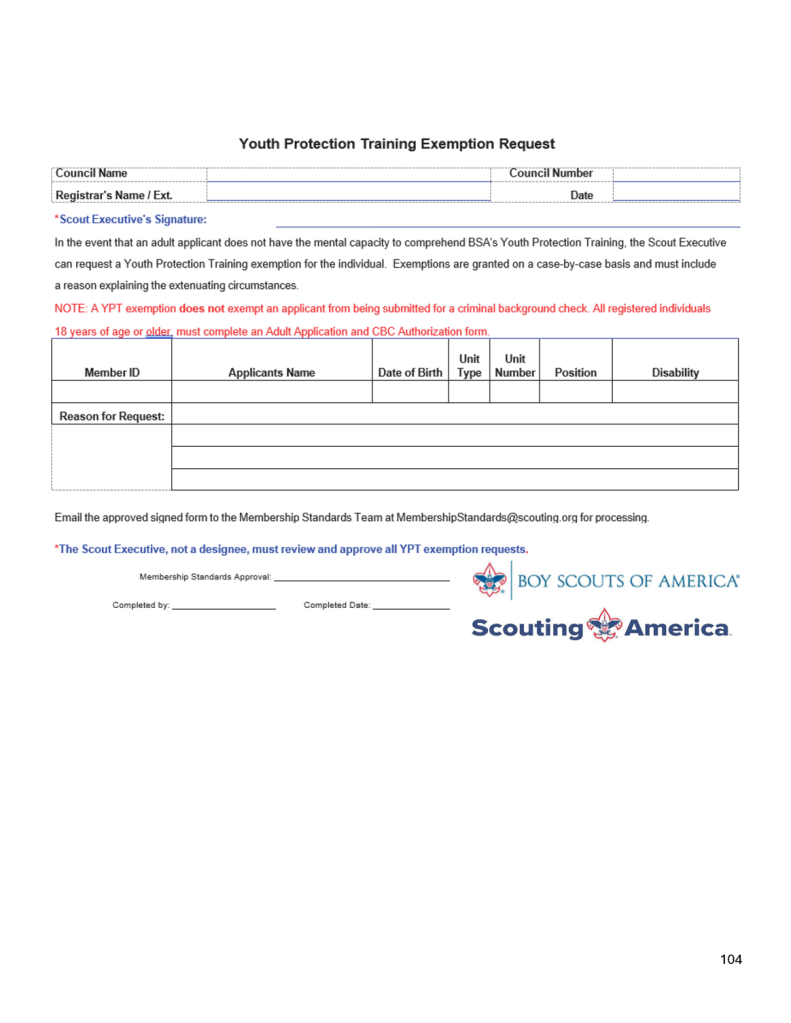
To begin with, the Barriers to Abuse require all adult Scouts to complete Safeguarding Youth (youth protection) training before they can be registered members of Scouting America unlessthey “do not have the mental capacity … to comprehend the concepts being delivered in Youth Protection training (YPT).”[1] In those situations, the Scout executive can request a YPT exemption for the individual. YPT exemption requests are submitted on the Youth Protection Training Exemption Request form[2] to the Scouting America Membership Standards Team, and when approved, that person’s profile is flagged as “YPT not Required”. This process can be slow. Another complication is that while this exemption is intended to be granted permanently, at this time (2025) the automated computer tracking system for YPT training compliance flags members with exemptions every two years so that the Scout Executive has to resubmit the exemption request to reset the training clock.
The group of people who are unable to comprehend the concepts of Safeguarding Youth training is smaller than the group of people who qualify for RBAE. By the rules, any adult Scout that can understand Safeguarding Youth training at any level must complete it. At present, there is no national guidance about whether or not an adult Scout can have a live facilitator to help the Scout understand the material while they go through the online training module. According to the Registration Guidebook, there is an option to the online training. An in-person training is allowed as long as the current Facilitator’s Guide for In-Person Youth Protection Training YPT curriculum is used.
With the rules out of the way, we can discuss the practicalities. The Barriers to Abuse do not address the fact that some RBAE adult Scouts are vulnerable to grooming, if an abuser wanted to take advantage of them. So it is good sense to apply similar barriers to protect them like we would for a youth in Scouting America. While it is unlikely that an RBAE adult Scout could effectively groom another person for abuse, an RBAE adult Scout might exercise poor judgment and physically touch a person in an unacceptably intimate way. If that happens, we must follow the incident reporting procedures in Barrier to Abuse so public authorities and Scouting America can investigate, like we would for any other adult.
[*] At the time of this writing in mid-2025, the Scouting America terminology for youth protection is in flux. As you read this module you will see a disconnect. The new name of the required training course “Safeguarding Youth” is used where it refers to the course itself, and the older terms “Youth Protection” or “YPT” are used in regard to the broader policies and procedures, and in the names of preexisting forms and documents.
[1] Registration Guidebook
[2] The form is in the Appendix of the Registration Guidebook and for convenience is also attached at the end of this module
REGISTERING ADULT SCOUTS
There is a lot of extra paperwork required to register adults (over 18) beyond the age of eligibility (RBAE adults). As a practical matter, the leader of a unit with adult Scouts will need to coordinate with the council registrar, who is a Scouting professional employed by the local council. Hopefully your registrar is experienced with the RBAE process spelled out in the Registration Guidebook, which treats RBAE adults as an “exception”. If not, you may need to work through the process together until everyone gets the hang of it.
Before You Start
You need to figure out whether the person you want to register is capable of understanding the concepts in Safeguarding Youth training and can complete it. That is because you will need to submit either a Safeguarding Youth training certificate or a YPT Exemption Request form at the same time as the Request for RBAE. Similar logic and documentation will need to be presented for both requests, so it can be put together as one package.
Required Documents
Seven documents are required for each participant. Plan on all of these being printed out as hard copy documents so you can collect the hand signatures. Current systems are not ready for electronic submittals.
- Scouting America Form 512-935 – Request for Registration Beyond the Age of Eligibility[1]
- A letter from a parent or guardian that describes the disability and its severity and permanence, and asks the council for approval of registration beyond the age of eligibility.
- A signed statement from a qualified health professional attesting to the nature of the disability, its severity, and the permanent limitations connected with it.
- A letter from the unit leader advocating for the registration
- A completed adult application (Scouting America Form 524-501) for individuals 18 years old and over. This includes an authorization for a criminal background check.
- Either a certificate that Safeguarding Youth Training has been completed or a YPT Exemption Request form.
- Scouting America Form 680-001 – Annual Health and Medical Record form (parts A, B, and C)
Supplemental Documents
Ultimately, a decision has to be made that an adult has circumstances where participating in Scouting is good for and appropriate for that individual. The seven required documents might not tell a complete enough story to make a decision. You may submit other documents, like an Individualized Education Plan (IEP) or a treatment summary, to help the reviewer understand the situation. Another effective way to do this is to create a Day in the Life document that tells everything extra or different that has to be done to support that person to make it through a typical day.
No Social Security Number?
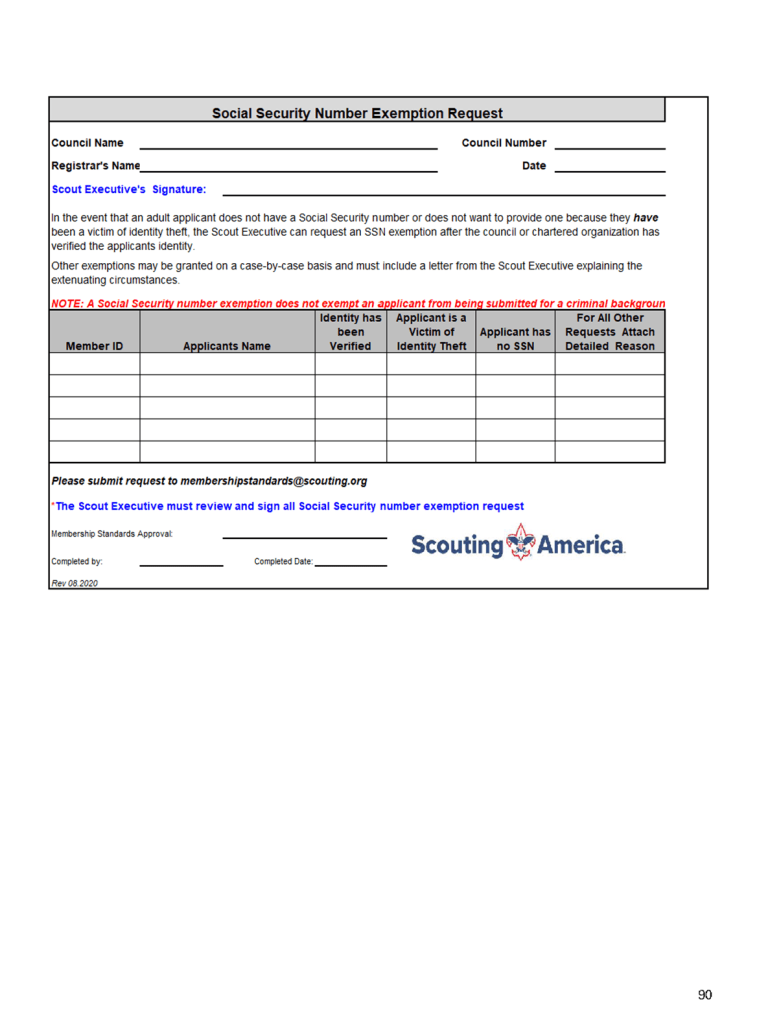
All adult applications trigger a criminal background check, including adult RBAE Scouts. It does not matter if the person is low functioning or would seem like zero risk of criminal behavior. By itself, the background check should not be a problem if there is nothing to find. Normally a social security number (SSN) is required with an adult application as a starting point for the background check. Sometimes a person with a disability does not have a social security number or needs to withhold it because of past identity theft. The council Scout Executive can request an override of the SSN requirement from the Scouting America Membership Standards department, but there is an extra process to get an exemption[2]. The council registrar has instructions on how to do this in the Registration Guidebook. Even without a SSN, the council needs to document how it established your identity.
Supporting the Youth Protection Training Exemption Request
As mentioned earlier, the form for making this request is in the appendix of the Registration Guidebook and a copy has been included at the end of this module. It has to be approved by the council Scout Executive and submitted to the Scouting America Membership Standards department. The form has a place to state the reason for the request, but realistically the Scout Executive will need supporting information. If the person you are registering does not have the capacity to take youth protection training, it will help if the required supporting letters from the Parent/Guardian and Unit Leader explain this point. It is also a good idea to address it in the statement of the qualified health professional.
Getting a Doctor’s Note
In general, the hardest document to obtain for RBAE registration is the signed statement from a qualified health professional. It is a rare professional that will devote the time for a detailed and comprehensive letter to serve Scouting America’s purposes. As the unit leader, you can save a lot of time and difficulty by creating your own simple form letter where only a few blanks need to be filled in and most of those can be filled in before the letter is given to the professional for a signature. Section 10 in Guide to Advancement (Scouting America 33088) has more information about what needs to go into the letter, but the key elements are (1) what is the disability, (2) confirm that it will be long-term, meaning in excess of two years, and (3) confirm that the extent of the disability “precludes advancement even at a rate significantly slower than considered normal”.
Disability Designations
There is a lingering historical artifact in the Scouting America membership system that you need to be aware of. When a member has been approved for RBAE status, a disability designation is recorded in their personal profile. There is not a place on the forms to pick which designation you want to apply, but your Registrar might ask you for one. Only eight categories exist in the computer[3]. Unfortunately, the names are outdated and don’t match most Scouts well. Fortunately, it makes no difference to the RBAE approval process which designation gets assigned.
[1] The current 512-935 form has two known errors compared to the authoritative Registration Guidebook. The form only asks for Parts A & C of the AHMR, and the form does not have a place for the YPT certification/exemption form to be checked off.
[2] For convenience, a copy of the SSN exemption form is included at the end of this module.
[3] Developmental, Emotional, Hearing Impaired, Learning Disabled, Mentally Disabled, Orthopedically Impaired, Multiple Disabilities, and Visually Impaired.
RECHARTERING A UNIT WITH ADULT SCOUTS
Recently, changes were made to make the renewal cycle for individual memberships independent of the recharter cycle for the units. Even before these changes, the internet recharter process did not handle RBAE Scouts well. As a practical matter, a unit that has adult Scouts as members should expect to have to go through manual, paper-based, processes. The most straightforward approach is to reach out to the council registrar for directions and to coordinate the process.
OPERATING A SPECIAL PUTPOSE UNIT FOR ADULTS
The information in the rest of this module addresses strategic aspects of operating a unit. Module P – Understanding Intellectual Disability has more information about how to work directly with a Scout to teach skills. It is wise to review Module P as well.
The Consistent Caring Adult
Scouts enjoy the program more and get more out of it when they have a parent, guardian, or family member supporting their Scout activities, getting them to meetings, and encouraging them to accomplish things. This is still true for an adult Scout, but the consistent caring adult in their lives may be different than you expect for a youth member. The parent/guardian of an adult Scout might be elderly and not able to be there in person for Scout events. Sometimes a sibling fills this role for the Scout. Sometimes it is a professional caregiver that watches over the adult Scout day to day. It is not unheard of for an adult Scout to have no surviving family members and be a ward of the state. You want to encourage a consistent caring adult for each Scout to be actively involved with the unit and to attend most events.
Transportation
Not all adult Scouts will be able to drive themselves to meetings or events. Some will live at home with relatives, others will live in supported living facilities near their family, and some will have no close family at all. It may take an organized plan to get members together in one location for meetings and events. Even though the Scouting America Barriers to Abuse don’t address one-on-one contact between adult volunteers and adult Scouts, it makes good sense to give a “vulnerable adult” the same protections as a youth who is riding in a vehicle with an adult.
Camping
“Outing” should still be part of “Scouting” with a special purpose unit. In general, we still want to camp with these Scouts, but the charter organization or the medical condition of the Scout could place restrictions on overnight camping. Special purpose units may need to reinvent some activities as day outings that would usually happen on a campout. Most of the time, each Scout needs a responsible person, at a one-to-one ratio, to watch over them on an outing. For the first campout with any of these Scouts, it is wise to have a family member along on the campout. The point is for there to be someone familiar that the Scout absolutely trusts along on the outing to comfort or calm the Scout.
Communication
While all Scout units run better when all of the families and the charter organization are kept informed of the unit activities, this is even more important for special purpose units with adult Scouts. Each person has a larger support network than a typical youth Scout would have. Extra efforts are needed to coordinate with adult siblings, spouse/partner, the Scout’s housing provider, professional caregivers, health providers, sheltered employers, unit sponsors/supporters, etc.
Displays of Affection
The adult Scouts we serve in a special purpose unit are in a different place in life from youth Scouts. While they are enjoying youth-oriented Scouting activities, they also see themselves as adults, with all of the complexity of adult relationships. For instance, a Scout could be married, in a dating relationship, or living with a significant other. In addition, adults with intellectual disability can behave toward people of the opposite sex in ways that make sense to them but seem inappropriate to others. Usually the issue is just flirting, but sometimes it is attempting to hug or to kiss someone. The person that is the object of interest could be much younger or older than the adult Scout.
In the context of a Scout unit, it is important to have simple clear rules for what is and isn’t allowed to happen in a Scout setting, like “no hugging”, and to consistently enforce the rules without being harsh. When the unit is on an outing on its own, where everyone knows each other well and they know who to watch out for, you may be tempted to let odd behavior slide. But, it is important to maintain the boundaries there just as much as you would in a public setting or at a multi-unit Scout event. In particular, watch out for times when the object of interest is a young person staffing a large event. That staffer needs to be protected from an uncomfortable interaction just as much as the adult Scout does.
Advancement
Module P provides more detailed information about how to teach and tailor activities to allow Scouts to earn ranks and badges. Even when an adult learns slowly, it is worthwhile to have opportunities to learn and grow. The biggest difference in advancement for the unit leaders is the need to record completion in small increments over long stretches of time. By the time a Scout reaches a rank and a board of review they may have forgotten all that was accomplished. The best tool for recording progress is photography. Pictures taken over time can be assembled into a physical scrapbook or an electronic PowerPoint presentation to help the Scout show and tell others what they have done.
Leadership Experience
With youth Scouts in traditional units we want to challenge them to take on leadership and responsibility. The same philosophy should apply to adult Scouts and to youth Scouts that have a disability. We want to run a special purpose unit in as similar a fashion to a traditional unit as the circumstances allow, including Scout leadership of other Scouts. An important dimension of this is to intentionally give Scouts with disabilities chances at the full range of positions and not just the non-elected or lower profile positions. No one should be placed on the sideline.
Tent and Shelter Arrangements
The Scouting AmericaBarriers to Abuse have become complex in terms of who may share a tent or other shelter with whom, and separation of youth and adult tent groups. The system for youth uses age difference to segregate Scouts, and this doesn’t really have a counterpart for adult Scouts. As we explained earlier, in the section about IDENTITY, AGE, AND ABILITY, trying to establish a specific equivalent age for an adult Scout is not very workable. Given the variety of combinations of ages, genders, capabilities, caregiving needs, etc. that you could encounter, following all the regular rules may be impossible. No one else can tell you exactly what you should do, but remember that your Scout Executive has the authority to approve whatever arrangement you can come up with that protects your Scouts from abuse, in keeping with the spirit of youth protection. Your arrangement can be unique for your unit and your Scouts. Such an approval is supposed to be portable and allow you to camp at another council’s camps without repeating the approval process.
Shakedown Campouts
If your unit does not camp much, but you want to attend a larger activity like summer camp or a camporee, it is a good idea to have a smaller scale campout to let everyone try out the outdoor experience. In particular, you want the leaders that are taking the group to camp to get experience with Scouts they do not know well and learn any tips or tricks to getting along together. It also gives the Scouts and their family members a chance to try out gear and identify what kinds of accommodations they may need at camp. These outings are especially important when the Scout is accustomed to having a particular family member or caregiver around all the time, but that person cannot go to camp.
Competition Events at Camp and Camporees
It is a Scouting tradition to have multi-unit events where patrols or dens are asked to complete challenges for points or time and then winners for the challenges are announced at the end of the event. This will put a unit with adult Scouts in competition with more traditional units. There are two aspects to address for the unit with adult Scouts.
The first aspect is to address the difficulty of the challenge activity. The activity needs to be doable but still challenging for the Scouts in your unit. Take the earliest opportunity to talk to the people that will be running the events to figure out how they can adjust their activity. Ideally, you can do this ahead of time at a planning meeting for the event, but you may have to make the rounds of the activities on the morning of the event, ahead of your Scouts. It is better to adjust the task than just have preferential scoring.
The second aspect is being prepared for the emotional effects of competition. While youth Scouts can be bad winners or bad losers, just due to size and strength if adult Scouts act out, you want to prepare them for a competition environment. Talk in advance about how a good sport behaves and how to handle themselves when they win or lose. A lot of challenge activities will have different Scouts doing different tasks, so you can pre-assign some roles to reduce risks of poor sportsmanship. For instance, it might be better to have someone assigned to encouraging/cheering on the others rather than being “in the heat of battle”.
Summer Camp and Interacting with Other Units
Don’t be afraid to take a unit with adult Scouts to a camporee or summer camp where they will be alongside traditional units. It is a good idea to reach out to the other units that are at camp that week during the opening leader meetings and invite them to come by and visit your campsite. You want them to understand that being different can be a good thing. Some youth will have a natural affinity for adult Scouts and want to spend time with them.
We want all Scouts to have the chance to make friends with Scouts from other units that they meet at camp, and this is no different for adult Scouts. Assuming you know the abilities and personality of the adult Scouts in your unit, you can adjust how you provide supervision to account for their individual circumstances. Think about how the Scouts will navigate themselves around the camp and whether they present a risk of wandering off. Will they need extra help during merit badge classes and other camp activities? Would it help you to recruit some adults or mature Scouts from other units at camp to help out?
High Adventure
Don’t assume a special purpose unit cannot do high adventure opportunities. As the Special Olympics program demonstrates, most adult Scouts do not have significant physical disabilities and can accomplish most high adventure activities if they are just given a chance to try.
Recently, the Scouting America National High Adventure Bases have developed programs to accommodate people with disabilities and expand opportunities to participate in treks and adventures. These are available to a special purpose unit with adult Scouts and to individual Scouts and their families. The bases cannot guarantee that every single activity can be adapted for every single Scout, but every Scout should be able to have an experience that is an adventure for them, even if it looks a little different from others.
Advance coordination is required when your unit goes to a high adventure program. It may feel like a vetting process to screen out campers who cannot do everything, but that is not the case. The purpose of the coordination is to learn what works for your campers and what unusual things they will need, so the base can plan ways to make things work.
A FINAL WORD
The authors of this module have done their best to give you information that helps you run a unit with adult Scouts. At the same time we know that there are people out there with first-hand experience in such a unit who know things we should add to future editions of this module. If that is you, please reach out to us at SpecialNeedsChair@Scouting.org.
Uploaded: January 19, 2026
Authors: Ben Burns, Charles Hulse, Janet Kelly, Eleanor Philips
Editor: Roger B. Tate
Reviewed by: Members of Scouting America Special Needs and Disabilities Committee
 Able Scouts
You must be logged in to post a comment.